









If you have ever looked at a gym membership, winced at the price, and thought “maybe later,” you are not alone. Here is the good news: you do not need a gym to build real, visible muscle — learning how to build muscle at home is simpler than most people think. Your body is the equipment. With the right exercises, a bit of consistency, and enough food and sleep, you can get noticeably stronger at home — no dumbbells, no machines, no monthly fee.
This guide is for complete beginners. No jargon, no impossible routines. Just a plan that actually fits into a normal life.
Can You Really Build Muscle at Home?
Yes — and the science is straightforward. Muscles grow when they are challenged a little more than they are used to. That challenge does not have to come from iron plates. It can come from your own body weight, done with good form and gradually made harder.
The catch? You cannot do the same ten easy push-ups forever and expect change. You need progressive overload — a fancy phrase for a simple idea: make things slightly harder over time. More reps, slower reps, harder variations. That is the whole secret, and it works at home just as well as it works in a gym.
The 6 Best Bodyweight Exercises for Building Muscle
You do not need twenty exercises. You need a few good ones, done well. These six cover your whole body.
1. Push-ups (chest, shoulders, triceps)
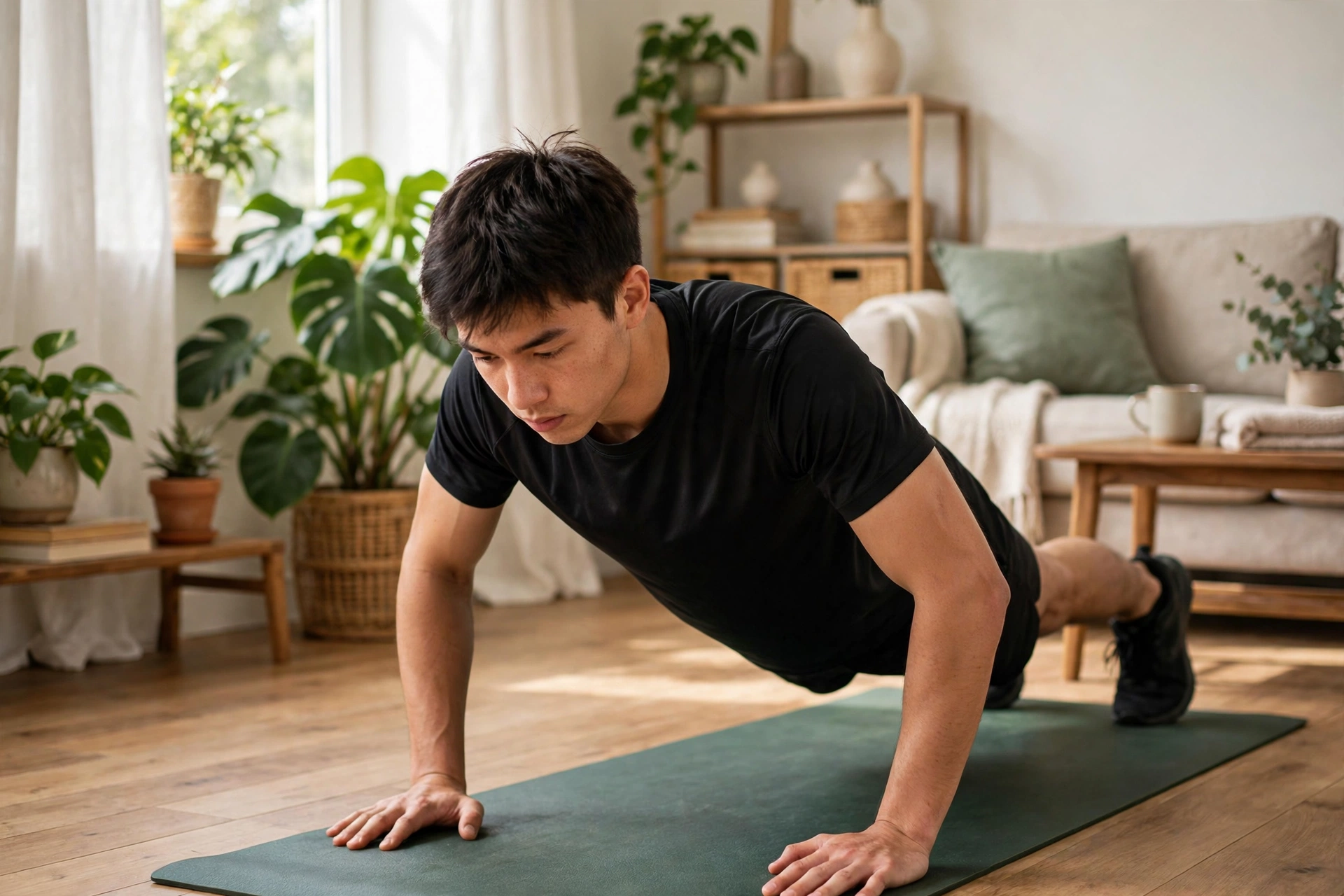
The classic, and still one of the best. Keep your body in a straight line from head to heels, lower your chest slowly to the floor, and push back up. If full push-ups are too hard right now, start on your knees or with your hands on a sturdy table — then work your way down to the floor. Aim for 3 sets of as many good reps as you can do.
2. Squats (legs and glutes)
Stand with your feet shoulder-width apart, push your hips back like you are sitting into an invisible chair, and lower until your thighs are roughly parallel to the floor. Keep your chest up and your knees tracking over your toes. To make it harder, pause for three seconds at the bottom, or try slow 5-second descents.
3. Lunges (legs, balance, glutes)
Step forward into a deep lunge, lower your back knee toward the floor, and push back to standing. Alternate legs. Lunges are brilliant because they build strength and balance at the same time — and they expose (and fix) the difference between your stronger and weaker leg.
4. Plank (core)
Hold a straight line on your forearms and toes, squeeze your glutes, and breathe normally. Start with 20–30 seconds and build up. A strong core is not about six-pack abs; it is what keeps your back safe during every other exercise.
5. Glute bridge (glutes and hamstrings)
Lie on your back, knees bent, feet flat on the floor. Push through your heels and lift your hips until your body forms a straight line from shoulders to knees. Squeeze at the top for a second. This one is deceptively simple — and your glutes will feel it the next morning.
6. Pike push-ups (shoulders)
Bend at the hips so your body makes an upside-down V, hands on the floor, and lower the top of your head toward the ground. This shifts the work onto your shoulders and is the closest thing to an overhead press you can do without weights.
How to Build Muscle at Home: A Simple Weekly Plan That Actually Works
You do not need to train every day. Three days a week is enough to start, and it is far better than an ambitious six-day plan you abandon by week two.
- Monday: Full-body workout — push-ups, squats, lunges, plank, glute bridge (3 sets each)
- Tuesday: Rest or a gentle walk
- Wednesday: Full-body workout — same exercises, try one more rep per set than Monday
- Thursday: Rest
- Friday: Full-body workout — same exercises, try a harder variation on at least one move
- Saturday and Sunday: Rest, walk, or stretch
That is it. Three honest workouts a week, about 25–30 minutes each. Health experts recommend adults aim for at least 150 minutes of moderate activity each week — see the NHS exercise guidance for the details. After 4–6 weeks, add a fourth day or split the work into upper-body and lower-body days.
If you want more exercise ideas to mix into your routine, check out these 20 different types of exercises you can do at home — many of them need no equipment at all.
How to Make Bodyweight Exercises Harder (Without Buying Anything)
This is where most home workouts stall. The fix is simple — pick one of these tricks each week:
- Slow down. Lower yourself for 3–5 seconds on every rep. Slow reps are brutally effective.
- Add reps. When you can do 15 clean reps, it is time for a harder variation.
- Pause at the hardest point. Hold the bottom of a squat or push-up for 2–3 seconds.
- Use a backpack. Fill an old backpack with books and wear it for squats and push-ups. Instant weight.
- Shorten your rest. Rest 60 seconds between sets instead of 2 minutes.
Small increases, week after week, are what build muscle. Nobody transforms in a weekend — but almost everyone who sticks with it for two months sees a real difference in the mirror and in how their clothes fit.
Eating for Muscle: You Cannot Out-Train an Empty Plate
Here is the part people skip, and then wonder why nothing changes. Muscle is built from protein, and your body needs enough of it — plus enough total food — to grow.
- Eat enough protein. A good starting target is around 1.2–1.6 grams per kilogram of body weight per day. Eggs, lentils, chicken, yogurt, beans, and fish all count. If you are unsure how much you personally need, read our guide on how much protein you really need.
- Do not fear carbs. Rice, bread, oats, and potatoes give you the energy to train hard. Muscle building is not a low-carb project.
- Eat a little more than usual. If you are constantly in a big calorie deficit, your body will not prioritize building muscle. A small surplus — an extra snack or a slightly bigger dinner — is enough.
- Drink water. Muscles are mostly water, and even mild dehydration makes workouts feel harder than they are.
And timing matters less than people think. What you eat around your workout helps, but the total across the day matters most. For simple ideas, see what to eat before and after a workout.
Recovery: Where the Muscle Actually Gets Built
This surprises beginners: you do not build muscle during the workout. You build it while you recover. The workout is the signal; sleep and rest days are when your body answers it.
- Sleep 7–9 hours. Growth hormone does most of its work while you sleep. Short nights quietly undo good training.
- Take rest days seriously. Sore muscles need 48 hours before you train them hard again. That is why the plan above spaces workouts out.
- Stretch lightly after workouts. Five minutes of gentle stretching keeps you mobile and reduces next-day stiffness.
If you train hard on Monday and feel sore on Tuesday, that is normal. Walk, stretch, eat well — and come back stronger on Wednesday.
Common Mistakes Beginners Make
- Rushing the reps. Fast, sloppy reps with bad form build nothing but bad habits. Slow down.
- Skipping legs. Upper body gets all the attention, but your legs are half your muscle. Train them.
- Changing the plan every week. Pick a routine and give it at least four weeks before judging it.
- Comparing yourself to others. The person on social media has been training for years. Compare yourself to last month’s you.
- Quitting after two weeks. The first visible changes usually show up around week 6–8. Most people quit in week 3 — right before it starts working.
How Long Until You See Results?
Be honest with yourself about this one. In the first 2–3 weeks, you will feel stronger before you look different — stairs get easier, push-ups get easier, your posture improves. Around 6–8 weeks, friends may start to notice — if you have followed this guide on how to build muscle at home consistently. Around 3 months, the change is obvious in photos.
Take a photo on day one. You see yourself every day, so you will miss the gradual change. A photo does not lie, and it is the best motivation there is.
Getting Started Today
You do not need to buy anything, join anything, or wait for Monday. Right now, do one set of push-ups and one set of squats. However many you can do with good form. That is your starting point — write it down somewhere.
Then do the same thing on Wednesday. And Friday. That is how to build muscle at home: not with a perfect plan, but with a decent plan repeated for weeks.
Your living room is enough. Your body is enough. Start today.
Disclaimer: This article is for informational purposes only and is not medical advice. If you have a health condition or concerns, please consult a qualified healthcare professional.