







The Little Box That Lies to You (And How to Catch It)
Here’s a confession: I spent years grocery shopping the wrong way. I’d grab the box with the big “HIGH PROTEIN” banner, or the cereal that screamed “LOW FAT!” in bright letters, and I’d feel great about myself all the way to the checkout. Then one day, out of pure boredom in a checkout line, I actually flipped a “healthy” granola bar over and read the back. Thirty-two grams of sugar. Per bar. That’s basically dessert wearing a gym outfit.
That’s the moment I learned the most important lesson in grocery shopping: the front of the package is marketing. The back is the truth. And the Nutrition Facts label — that little white box most of us ignore — is actually a cheat sheet, once you know how to read it in under a minute.
So let’s fix that. Here’s how to read a nutrition label in 60 seconds, no calculator required.
Seconds 1–10: Check the Serving Size First
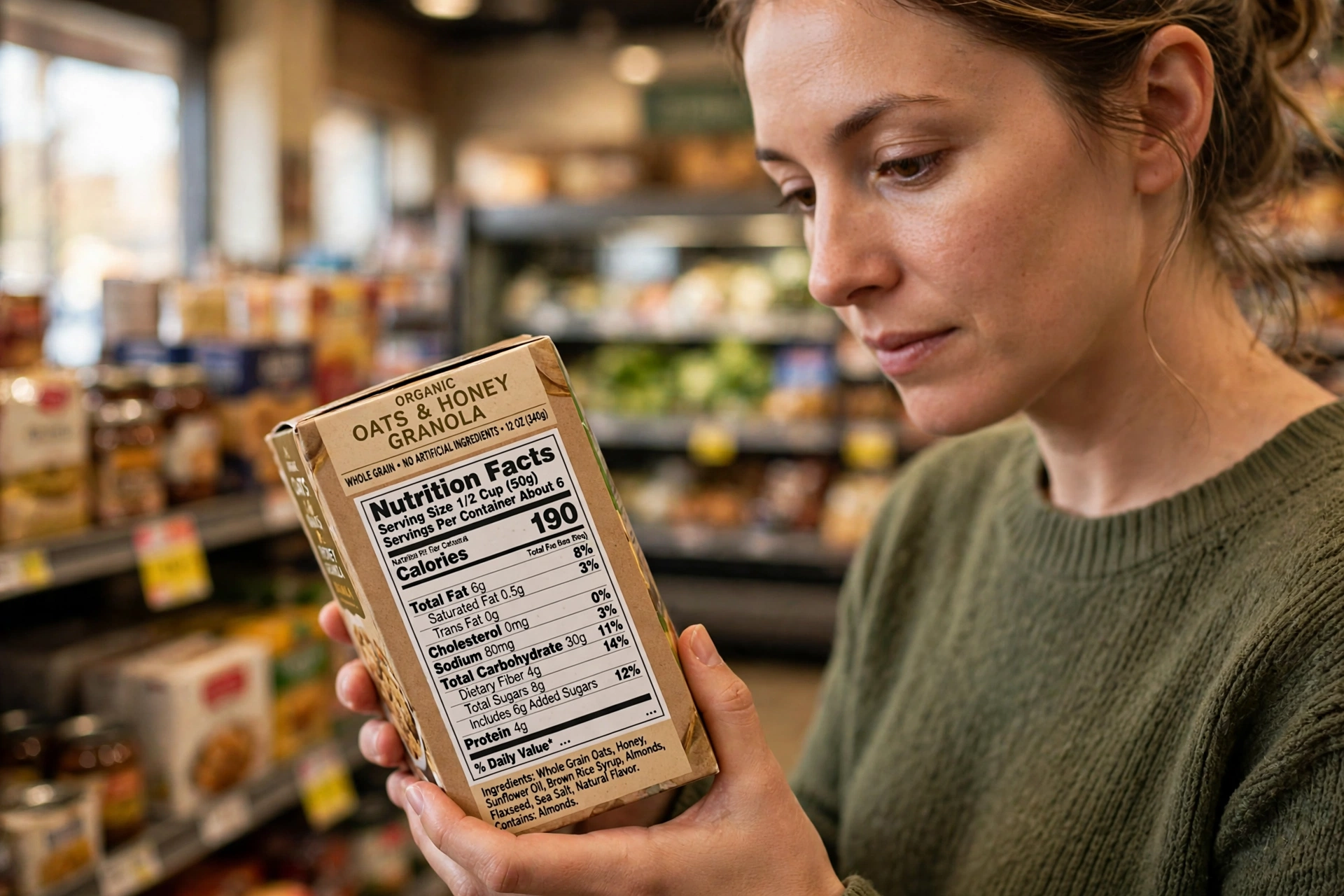
This is where almost everyone gets tripped up. The label doesn’t tell you what’s in the whole bag — it tells you what’s in one serving, and companies love to shrink that serving to make the numbers look better.
That bag of chips that says “150 calories”? The serving size might be 8 chips. The bag contains six servings. Nobody eats 8 chips. Do the honest math: 150 × 6 = 900 calories if you finish the bag on the couch during a movie. Which, let’s be real, is exactly what happens.
The 60-second rule: glance at the serving size, glance at servings per container, and multiply if you know you’ll eat more than one serving. Ten seconds, and you’ve already avoided the biggest trap on the label.
Seconds 10–25: Scan Calories and the Big Three
Right under serving size, you’ll see calories per serving. Don’t obsess over the exact number — just use it as a rough anchor. For most packaged snacks, anything over 250 calories per serving deserves a second look.
Then check the three macronutrients:
- Total fat — not all fat is the villain. Look at the breakdown: saturated fat is the one to keep low (under 5–6g per serving is a reasonable target). Trans fat should be zero, full stop.
- Total carbohydrate — includes sugars and fiber. This is the line where things get sneaky, so keep reading.
- Protein — aim for at least 5–10g in something calling itself a meal or a protein snack. A “protein bar” with 4g of protein is a candy bar with good PR.
Quick trick: compare two similar products side by side. The differences jump out instantly — same shelf, same price, but one has half the sodium and twice the fiber. Fifteen seconds, better choice.
Seconds 25–45: Find the Sugar and the Fiber
This is where the real detective work happens. Under “Total Carbohydrate,” you’ll see Total Sugars and, crucially, Added Sugars — the line that tells you how much sugar the manufacturer put in versus what was naturally there.
A yogurt with 20g of total sugar sounds scary until you see that only 4g are added — the rest is lactose, milk’s natural sugar. A fruit juice with 30g of sugar and 28g added? That’s soda’s quieter cousin.
Here’s my personal rule of thumb: if added sugars are more than half the total carbs in a savory product, or more than 10g per serving in a sweet one, it goes back on the shelf. Your call may differ, but having a rule beats having none.
Now flip to Dietary Fiber. Fiber is the quiet hero — it slows digestion, keeps you full longer, and feeds your gut bacteria. Look for at least 3g per serving in breads, cereals, and snack foods. A “whole grain” bread with 1g of fiber is whole grain in name only.
One more: sodium. It’s measured in milligrams and it’s easy to blow past your daily limit on packaged food alone. One serving of canned soup can carry 700–900mg — nearly half a day’s worth. If a product has more than 20% of your Daily Value for sodium per serving, treat it as salty, whatever the front of the box says.
Seconds 45–60: Read the Ingredient List Like a Story
The ingredient list is the label’s final twist — and it’s ordered by weight. The first three ingredients are what the product is mostly made of. If a “whole grain” cereal lists sugar as ingredient #2, it’s a dessert that woke up early.
A few things I scan for:
- How many ingredients? More isn’t automatically bad, but if you can’t pronounce half of them, be suspicious.
- Sugar’s disguises. It hides behind 60+ names — maltodextrin, fruit juice concentrate, cane syrup, dextrose, agave nectar. If three different syrups appear in the first five ingredients, they’re splitting one big sugar hit into smaller-looking pieces.
- Oils and additives. Partially hydrogenated oils mean trans fats. Some people also avoid artificial colors and certain preservatives — that’s a personal call, but the label lets you make it.
- The shortest list wins. Peanut butter with two ingredients (peanuts, salt) beats peanut butter with twelve. Usually.
Three Traps the Front of the Box Sets for You
Now that you can read the back, here’s what the front is really saying:
- “Low fat” / “Fat free” — fat was removed, so flavor had to come from somewhere. Check the sugar line. It usually came from sugar.
- “No added sugar” — true, but fruit juice concentrate and honey are still sugar. Check Total Sugars, not just Added Sugars.
- “Made with real fruit” / “Contains whole grains” — how much? A blueberry muffin can legally contain a single blueberry. The ingredient list’s order tells you whether it’s a feature or a garnish.
Your 60-Second Shopping Routine
Next time you’re in the store, try this on one product — just one:
- 0–10s: Serving size vs. what you’ll actually eat. Multiply honestly.
- 10–25s: Calories, then saturated fat, protein, and sodium at a glance.
- 25–45s: Added sugars (the sneaky line) and fiber (the hero line).
- 45–60s: First three ingredients. Spot the sugar aliases.
That’s it. A minute of label-reading in the aisle can undo years of being marketed at. And here’s the funny part: once you start doing it, you can’t stop. You’ll be that person in the grocery store comparing two jars of pasta sauce like they owe you money. Welcome to the club — the snacks are better here.
Disclaimer: This article is for informational purposes only and is not medical advice. If you have a health condition or concerns, please consult a qualified healthcare professional.