









You know that feeling. Your shoulders are up around your ears, your jaw is clenched, and your mind is racing through a to-do list that never ends. Work, money, family, or just the noise of modern life — whatever the cause, stress creeps in quietly and then takes over everything.
Here’s the thing most people don’t realize: you don’t need an expensive retreat or a complicated routine to feel better. Learning how to manage stress naturally comes down to small, everyday habits that work with your body instead of against it. Some take less than five minutes — and they work in real life, on real busy days.
Let’s walk through ten of them.
1. Breathe Like You Mean It
It sounds almost too simple, but your breath is the fastest remote control you have for your nervous system. When you’re stressed, your breathing gets shallow and fast, which tells your brain there’s danger — even when there isn’t.
Try this: breathe in through your nose for four counts, hold for four, and breathe out slowly through your mouth for six counts. Repeat four or five times. That longer exhale is the key — it activates your body’s relaxation response.
If you want a few more techniques to try, our guide to 5 simple breathing exercises to calm stress in minutes walks you through them step by step.
2. Move Your Body — Even a Little
You don’t need a gym membership or an hour-long workout to get the stress-busting benefits of movement. A brisk ten-minute walk can lower cortisol, the stress hormone, and lift your mood almost immediately.
The science is straightforward: exercise releases endorphins, your brain’s natural feel-good chemicals, and it gives your mind something to focus on besides whatever is worrying you. Dancing in your kitchen counts — so does taking the stairs.
Pick something you actually enjoy. If you hate running, don’t run — walk, swim, garden, or play with your kids. Anything that gets you moving is medicine for a stressed-out mind.
3. Get Serious About Sleep
Stress and poor sleep feed each other in a vicious circle. You’re stressed, so you can’t sleep. You can’t sleep, so you’re even more stressed the next day. Breaking that cycle starts with protecting your sleep like it matters — because it does.
Aim for seven to nine hours and keep your bedtime roughly the same every night, even on weekends. An hour before bed, dim the lights and put the phone down — your brain needs that wind-down signal. A warm shower, a few pages of a book, or some gentle stretching can all help.
If your evenings feel wired and restless, our guide on how to build a relaxing evening routine that actually helps you sleep better has a simple routine you can start tonight.
4. Try a Few Minutes of Mindfulness
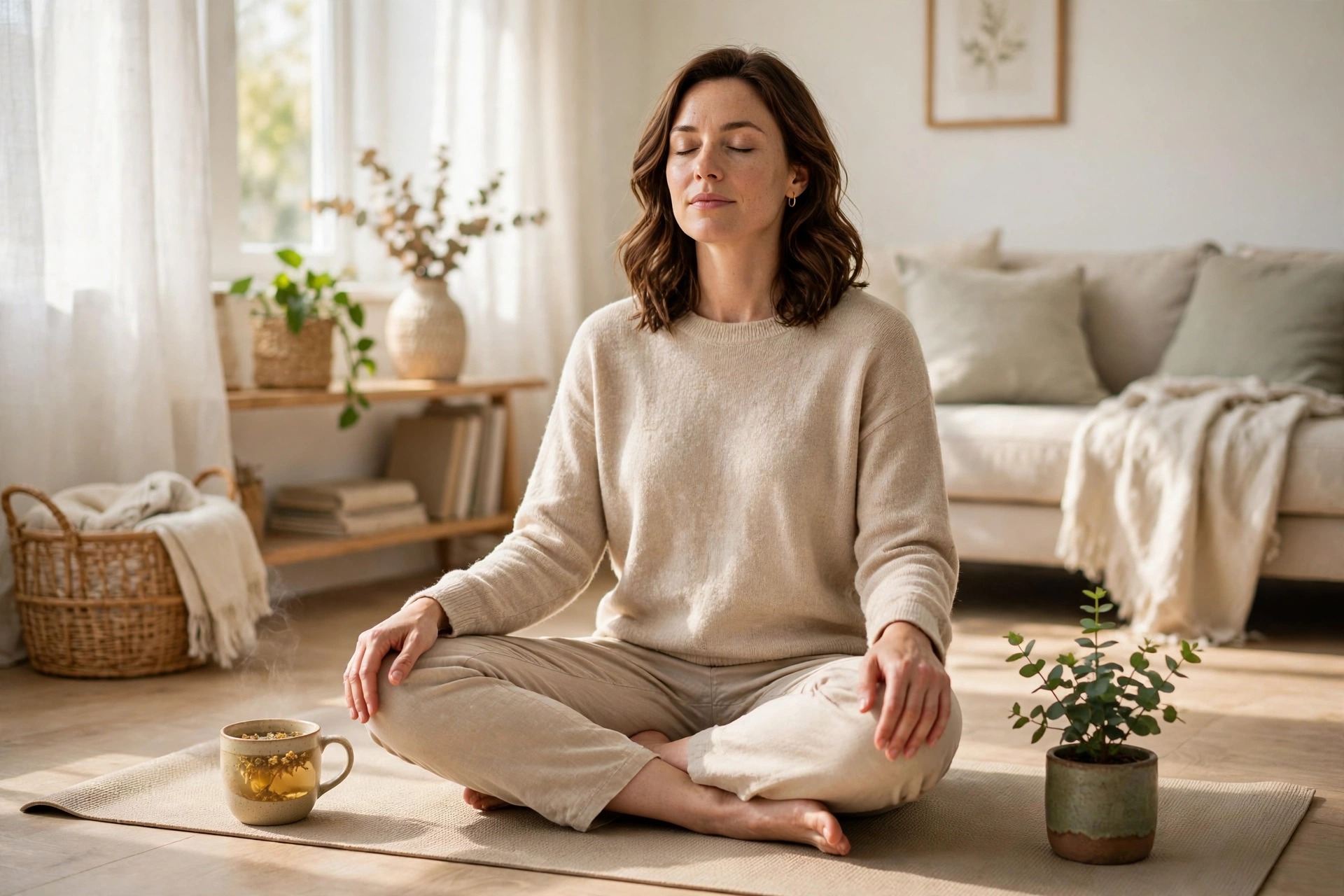
Mindfulness has a reputation for being complicated, but at its core it’s just paying attention to the present moment instead of replaying the past or rehearsing the future. And it doesn’t require sitting cross-legged for an hour.
Start with two minutes. Sit somewhere comfortable, close your eyes, and notice your breathing. When your mind wanders — and it will — gently bring it back. That’s it. That’s the practice.
Over time, this tiny habit trains your brain to pause before reacting — and that pause is where calm lives. Even five minutes a day makes a difference within a couple of weeks.
5. Eat in a Way That Supports Your Mood
When stress hits, most of us reach for sugar, caffeine, or whatever comfort food is closest. It feels good for about ten minutes — then the crash comes, and the stress feels worse.
You don’t need a perfect diet. Just a few steady habits help enormously:
- Eat regular meals instead of skipping them — low blood sugar makes everything feel harder
- Add foods rich in magnesium, like leafy greens, nuts, and bananas
- Drink enough water — even mild dehydration can raise stress hormones
- Cut back on caffeine after midday if your sleep is suffering
Think of food as fuel for your resilience — one more small, practical way to manage stress naturally, not another thing to stress about.
6. Spend Time in Nature
There’s a reason a walk in the park feels so different from a walk down a busy street: even twenty minutes in nature can lower stress hormones and blood pressure.
You don’t need a forest. A garden, a tree-lined street, or even sitting by a window with a view of greenery counts. Morning sunlight is especially powerful — it helps reset your body clock, which improves both your mood and your sleep. Our article on morning sunlight: the free daily habit that improves sleep, mood and energy explains why this simple habit works so well.
7. Talk to Someone You Trust — A Simple Way to Manage Stress Naturally
Stress grows in silence. The moment you say out loud what’s bothering you, it usually shrinks a little. You don’t need advice or solutions — sometimes just being heard is enough.
Call a friend, or have tea with a family member. Even a short, honest conversation can break the feeling that you’re carrying everything alone. And if the stress feels too heavy or constant, talking to a professional isn’t a sign of weakness — it’s one of the smartest things you can do.
8. Set Boundaries and Learn to Say No
A lot of stress isn’t about what happens to us — it’s about saying yes to too much. Every extra commitment is a withdrawal from your energy account, and eventually the account runs dry.
Start small. You don’t have to say yes to every invitation, every extra task, or every favour. A simple “I can’t take that on right now” is a complete sentence. Protecting your time isn’t selfish — it’s how you stay well enough to show up for the things that truly matter.
9. Make Time for Something You Enjoy
When life gets stressful, fun is usually the first thing we cut — but that’s backwards. Hobbies, music, reading, cooking, gardening — whatever brings you joy — aren’t luxuries. They’re how your nervous system recovers.
Even fifteen minutes a day of something you genuinely enjoy can recharge you. Schedule it like an appointment if you have to. Your future, calmer self will thank you.
10. Cut Down the Noise
Constant notifications, endless scrolling, and the 24-hour news cycle keep your brain in a low-grade state of alert all day — no wonder we feel frazzled.
Try a small digital break: no phone for the first thirty minutes after you wake up, or one screen-free evening a week. Notice how different your mind feels. You might be surprised at how much calmer a quieter day can be.
Putting It All Together: How to Manage Stress Naturally, Starting Today
Here’s the honest truth: learning how to manage stress naturally isn’t about doing all ten things perfectly. Pick one or two that feel doable and start there — the breathing technique before your next meeting, or a ten-minute walk after lunch. Small steps, done consistently, add up to real change.
Stress is a normal part of life — it won’t disappear completely, and that’s okay. Learning how to manage stress naturally means building a life where stress doesn’t run the show. Start with one habit today. Your mind and body will notice the difference sooner than you think.
Disclaimer: This article is for informational purposes only and is not medical advice. If you have a health condition or concerns, please consult a qualified healthcare professional.